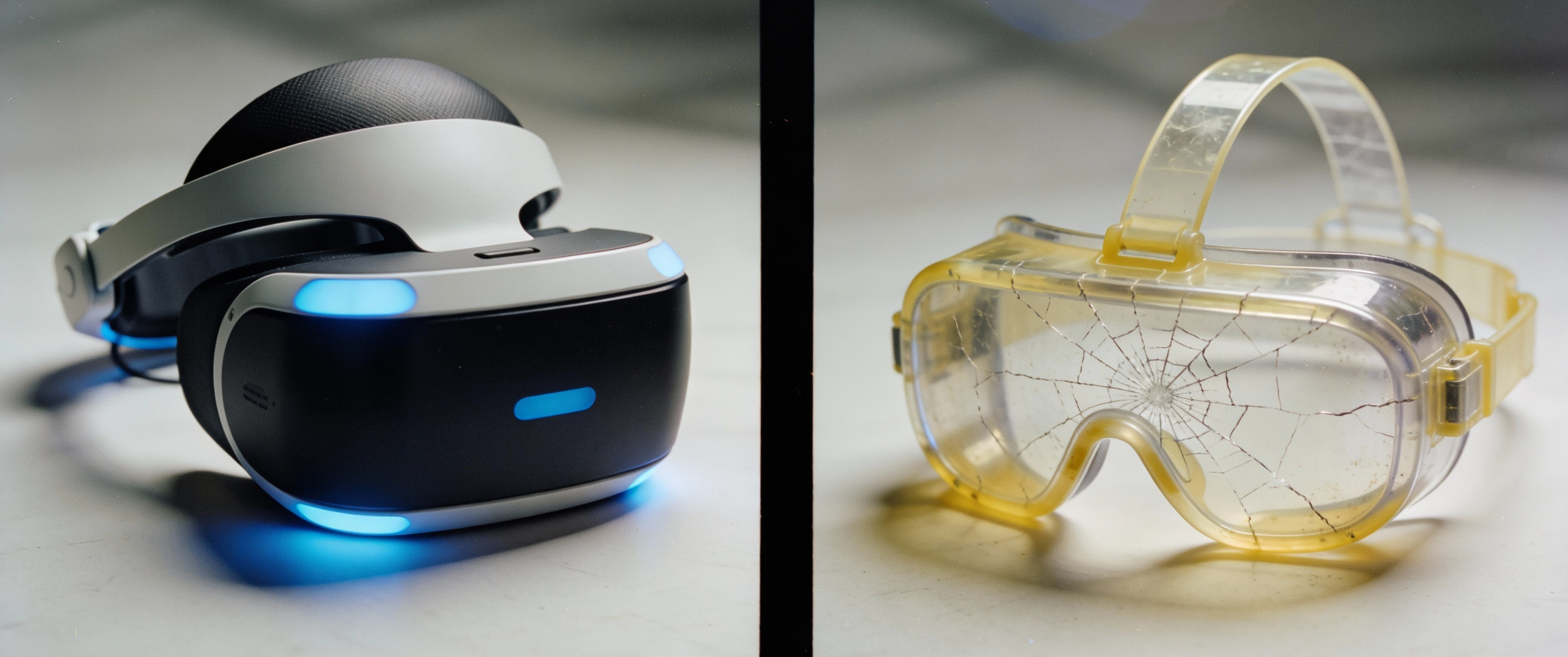
Why Most AR/VR Products Fail Before Launch
(And How to Avoid It)
Augmented and Virtual Reality have promised transformation for over a decade. Immersive learning, spatial collaboration, new forms of entertainment, the vision is compelling. And yet, most AR/VR products never reach meaningful adoption. Many stall at the prototype stage. Others launch quietly and disappear just as fast.
The common explanation is that the technology is “not ready yet.” In practice, that’s rarely true.
Most AR/VR products fail before launch because they are built as demonstrations of technology, not as products designed for people.
The Seduction of the “Wow Effect”
Almost every AR/VR project begins with a moment of excitement, a demo that feels magical. Walking around a virtual object. Interacting in 3D space. Experiencing presence for the first time.
That moment is important, but it’s also dangerous. Teams often mistake novelty for value. When the initial excitement fades, users are left asking a simple question: “Why should I come back?”
If the answer isn’t clear, immersion becomes optional. And optional products rarely survive.
Designing for Devices Instead of Human Intent
Another common failure point is designing around hardware constraints rather than human behavior. Controllers, gestures, spatial mapping, hand tracking, these are implementation details. Users don’t think in terms of inputs.
They think in terms of intent. When interactions demand too much physical effort or cognitive load, users disengage quickly. In immersive environments, discomfort isn’t a minor flaw, it’s a deal breaker.
Successful AR/VR products prioritize comfort, clarity, and effortlessness long before feature depth.
Prototypes That Cannot Survive Reality
Many AR/VR prototypes work beautifully in controlled demos. Performance is acceptable. Content is limited. Edge cases are ignored. The problems emerge when real users arrive. Without performance budgets, scalable content systems, and iteration pipelines, experiences collapse under their own complexity. A prototype that cannot evolve is already a dead end.
Ignoring the Physical World
Unlike traditional software, immersive products exist in physical space. Lighting conditions vary. Room sizes differ. Noise, interruptions, and fatigue are unavoidable. Products designed for ideal conditions fail in real ones. AR/VR experiences must assume short sessions, imperfect environments, and distracted users. Designing for reality is not a limitation, it is a necessity.
Unclear Measures of Success
A surprising number of teams cannot clearly define what success looks like. Is it session length? Repeat usage? Task completion? Retention after a week? Without clear metrics, teams rely on intuition and emotion. Progress becomes subjective, and problems remain invisible until it’s too late.
When XR Is Treated as a Side Project
AR/VR is often positioned as an experiment, a future bet, or a marketing initiative. That framing leads to limited ownership, inconsistent investment, and unclear accountability. Immersive products require the same discipline as any serious product: ownership, roadmaps, iteration, and long term commitment.
Final Thoughts
AR and VR are not failing because the technology is immature. They fail because product thinking is absent. Teams that succeed start with human intent, design for comfort and context, build scalable systems, measure what matters, and commit fully.
Immersive technology rewards discipline, not hype.